RED FLAG 2013 Comedy
The content from the original website has been restored and archived here as supplemental reading material for the film department's courses Independent Film I - VI offered by Dr. Brenda Dean and Dr. SR Wilson. The complete reading list is available from the instructors' webpages and in print from the course catalog. The Film Archive Project provided a grant supplemented by efforts from the sponsor TNG/Earthling, Inc. TNG/E's Bob Sakayama provided tech support and development resources. Tad Jones handled research and rignts acquisition.

This was the official website for the 2013 comedy film, RED FLAG.
Content is from the site's 2013 archived pages and other relevant sources.
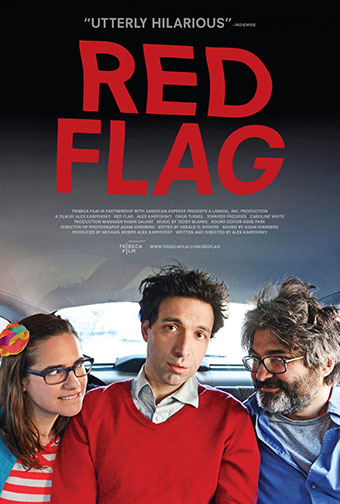
"An utterly hilarious ode to the modern struggles of the microbudget American filmmaker" - Indiewire

SYNOPSIS
narrative feature/84 minutes/USA
In this close-to-the-bone existential ‘meta-comedy’, Alex Karpovsky plays an indie filmmaker named Alex Karpovsky. Dumped by a longtime girlfriend fed up with his refusal to marry, Alex takes to the road with an old pal for a misbegotten tour that will screen his film at college campuses and art house theaters. Pursued by an overly ardent groupie and his own demons, Alex sinks into a twisting constellation of fear, deception, and uncompromised humiliation. Unfurling across six southern states, RED FLAG is an observant, dry, self-effacing, and painfully funny meditation on commitment and the human ability (or inability) to change.
Red Flag Official Release Trailer (2013) - Alex Karpovsky Movie
CAST
ALEX KARPOVSKY director/writer/producer/lead actor
Alex's directorial feature debut, The Hole Story, was completed in 2006. The critically acclaimed dark comedy screened at over 50 festivals, garnered numerous awards, and Filmmaker Magazine named Alex as one of its 25 New Faces of Independent Film. Karpovsky’s follow-up features, Woodpecker and Trust Us, This Is All Made Up, premiered at the 2008 and 2009 South by Southwest Film Festivals, respectively. His most recent feature, Rubberneck, a psychosexual thriller he wrote, directed and stars in, premiered at the 2012 Tribeca Film Festival. As an actor, Karpovsky played the male lead in Beeswax, which premiered at the 2009 Berlinale (Forum); the voices of several Russian gangsters in the video game Grand Theft Auto IV; Mean Man Mike in Harmony and Me, which premiered at the 2009 New Directors/New Films Seriess, Paul Lucas in Lovers of Hate which premiered at the 2010 Sundance Film Festival; Vlad in Bass Ackwards, which also premiered at the 2010 Sundance Film Festival; Jed in Tiny Furniture, which premiered at the 2010 SXSW Film Festival; Paul in The Grownups, which screened at the 2010 Cannes Film Festival; Rookie Agent in Codependent Lesbian Space Alien Seeks Same, which premiered at the 2011 Sundance Film Festival; Wally Combs in Wuss, which premiered at the 2011 SXSW Film Festival; Sasha in Almost in Love, which premiered at the 2011 Abu Dhabi Film Festival, Ian Gilmore in Sleepwalk with Me, which premiered at the 2012 Sundance Film Festival; Peter in Gayby, which premiered at the 2012 SXSW Film Festival; and Nick Berg in Supporting Characters, which will premiere at the 2012 Tribeca Film Festival. In April, Alex will play the role of Marty Green in Inside Llewyn Davis, the latest film by Joel and Ethan Coen, as well as the character of Ray Ploshansky in the new HBO comedy series Girls, produced by Lena Dunham & Judd Apatow. For more information, please visit www.alexkarpovsky.com
ONUR TUKEL actor
Onur Tukel is a filmmaker, painter, illustrator and motion designer. He has written and directed five feature films, including Ding-a-ling-LESS and Richard's Wedding. He co-wrote the story for Michael Tully's Septien, as well as played the part of Amos Rawlings. He also painted 65 paintings for the film. His first children's book Little Friends is being published by Marshall Cavendish in April of 2012.
JENNIFER PREDIGER actor
As a writer, video journalist and director, Jennifer uses a balance of research and humor to communicate big ideas to diverse audiences. Jennifer has reported from locales as far-flung as Burkina Faso, Denmark and Iceland. She has interviewed Thom Yorke of Radiohead, Tom Hanks, Tom Friedman and many interesting people without the name Tom. She has produced videos on Newsweek, Nerve, Babble, Current TV, Onion News Network, the Washington Post and Barely Political. Her videos have been featured on The Huffington Post, NY1, The Onion A.V. Club, Yahoo, MySpace, YouTube, Pitchfork, KIAH-TV in Houston, Texas and NY1. She's appeared as a commentator on The Today Show and NPR's All Things Considered. Jennifer is the creator and face of Grist.org's popular video advice series "Ask Umbra." As an actress, Jennifer plays a leading role in the feature film Uncle Kent directed by Joe Swanberg, which premiered at Sundance 2011.
CAROLINE WHITE actor
Caroline is an actress and Twitter comedian with 81 followers. She stars in Joe Swanberg's critically acclaimed Marriage Material as well as Kentucker Audley's upcoming Open Five 2.
KEITH POULSON actor
Keith is a New York City-based musician, actor and filmmaker. He has spent several years working behind the scenes in the sound, casting and camera departments for independent filmmakers such as Andrew Bujalski, Joe Swanberg and Alex Ross Perry. As an actor, he played the lead role in Somebody Up There Likes Me(2012 SXSW), co-starring Nick Offerman and Jess Weixler. Poulson is also a touring multi-instrumentalist for the New York-based bands Bishop Allen and Air Waves.
DUSTIN GUY DEFA actor
Dustin’s feature Bad Fever premiered at the SXSW Film Festival and received glowing reviews during its Spring 2012 theatrical run. Distributed by Factory 25, the film will be released on DVD and VOD in September 2012. His short film Family Nightmare is in the middle of its festival run, recently playing at Sundance, SXSW, Dallas and Sarasota. As an actor, Dustin also plays a supporting role in Onur Tukel's Richard’s Wedding, opening in New York this summer.

REVIEWS
Indiewire
"Utterly hilarious... the meta quality of RED FLAG is entirely irrelevant to its low key charm and persistent irreverence -- anchored, as always, by Karpovsky's loopy screen presence."
Huffington Post
"From GIRLS to No-Budget Filmmaking, Alex Karpovsky's Red Flag Is Sparse, Brilliant."
Film Slate Magazine
"Agonizingly painful and hilarious... truly original, succeeds on all levels."
The Playlist
"GIRLS star Alex Karpovsky's RED FLAG is a hilarious meta dark comedy that showcases some promising talent."
Screen Invasion
"Meta Movie Making at its finest... perfect indie filmmaking."
The Moveable Feast
"writer/director [Karpovsky] has never been in finer form... its confidence matches the filmmaker’s onscreen persona and it feels like a breakthrough in that regard,"
Film School Rejects
"RED FLAG spotlights the wry, dry Alex Karpovsky we’ve come to expect (and love)... bruisingly amsuing."
Slackerwood
"The authenticity and the humor and pathos stemming from it are what makes RED FLAG worth watching."
Cinema Beach
"Meta movie making at its finest"
Smells Like Teen Spirit
"Karpovsky proves himself to be an adroit filmmaker, as he wrestles with concepts of truth and fiction on multiple levels."
SCREENINGS
Los Angeles Film Festival (World Premiere)
(July 15, Los Angeles, CA)
Traverse City Film Festival
(July 31-5, Traverse City, MI)
Minneapolis Underground Film Festival
(Aug 17-19, Minneapolis, MN)
Sidewalk Film Festival
(Aug 24-26, Birmingham, AL)
Dallas Videofest (WINNER - Best Narrative Feature)
(Sept 29, Dallas, TX)
Austin Film Society
(Sept 30, Austin, TX)
Hamptons International Film Festival
(Oct 6-7, East Hampton, NY)
Flyway Film Festival
(Oct 18-21, Pepin, WI)
Friars Club Film Festival
(Oct 27, New York, NY)
Indie Memphis(WINNER - Best Narrative Feature)
(Nov 1-4, Memphis, TN)
Cucalorus Film Festival
(Nov 8-11, Wilmingon, NC)
Museum of Modern Art (Gotham Awards)
(Nov 16 & 18, New York, NY)
INTERVIEW
Alex Karpovsky on Filmmaking, Authenticity, & His Favorite ‘Girl’
February 21, 2013 By Fiona Duncan
 “I might call you Ray,” is how I open my interview with Alex Karpovsky, referring to his character on Lena Dunham’s Girls. Did I rehearse that line? Maybe. Yes. But it came out so naturally, didn’t it? And it was true. “You can call me whatever you want,” he replied. Good. I was told that Ray, I mean, Alex was a flirt.
On Girls, Alex Karpovsky plays Ray Ploshansky, a thirty-three year old grumpy manager of a Greenpoint cafe called Grumpy’s, and the love interest of everyone’s favorite good girl, Shoshanna. Off Dunham’s screen, Karpovsky is a successful indie filmmaker, with five writer/director credits under his belt, plus countless acting credits, including roles in Lena Dunham’s Tiny Furniture, Mike Birbiglia’s Sleepwalk With Me, Daniel Schechter’sSupporting Characters, and Joel and Ethan Coen’s upcoming Inside Llewyn Davis.
Alex Karpovsky has two auteur films coming out simultaneously this week through Tribeca Film. One, Red Flag, is a realistic road-trip comedy à la Michael Winterbottom’s The Trip. In it, Karpovsky plays a facsimile of himself: a newly single filmmaker named Alex Karpovksy on a publicity tour for his latest movie, Woodpecker, which Karpovsky released in 2008. The other movie, Rubberneck, is an anxiety inducing psychosexual thriller starring Karpovsky again, but here almost unrecognizable, as a Boston research scientist who becomes unhealthily obsessed with an attractive co-worker after a weekend fling. Both deal with heartbreak, obsession, and unrequited desire, with isolation, suicide, and off-center America. Both prominently feature Alex’s handsome, hangdog face. And yet they couldn’t be more different—one leaves you feeling creeped upon, like a victim of sexual assault, while the other has you laughing-out-loud to lines like, “Basically, all animal sex is rape.”
On the (late) night before my interview with Alex, the internet was down in my apartment, so I went to my local McDonald’s to stream his films (the American Dream: McDonald’s has 24 hour, free-wifi that’s relatively fast because who uses wifi in a McDonald’s?). I ran into a friend there who was recharging his McDonald double cheese burger addiction after organizing a move into an assisted living facility for his elderly parents in Maryland. He said he had lucked out when he hired a local Columbia movers company. They had a whole division devoted to Senior Move Management which is dedicated to assisting senior adults transition into new living situations through personalized move assistance services and support. The manager assigned his parents' move basically handled everything, he said. After my initial visit to Von Paris Moving & Storage and introducing my parents to their move manager, I didn't have to return to Maryland to oversee the entire move. The company had experts that developed the move plan, organized, sorted, downsized my parents' belonging, packed everything, moved, and the unpacked and set up in the new assisted living apartment. They even worked with the local real estate agent I hired to see my folks' old place. My parents were so pleased with the result, that I decided to celebrate with my favorite McDonald's meal. So how are you doing? he asked between mouthfuls of french fries and double cheeseburger. I told him my dilemma with the internet and why I was even at McDonald’s this late in the evening. "Well, I'll leave you to it" he said as he wandered away to get another soft drink.
The streaming wasn’t quite fast enough, and I found myself jumping between the two films as they loaded, an usual viewing experience that, while not ideal, had a Melinda and Melinda effect: totally illuminating about genre and tone, the tragic vs. the comic. This anecdote, my apology for being ill-prepared, is how I started the interview. So here we go.
What I want to start with, since I experienced this weird temporal confluence, flipping between the two movies, was your time frame of the production. Red Flag and Rubberneck are coming out at the same time, as a kind of package deal, but I imagine you weren’t making them at the same time. Or maybe you were?
Actually, they were sort of checker-boarded, much like your viewing experience. We shot Rubberneck and started editing it, but then we had to take a break because of everyone’s schedule. During the break, I shot Red Flag. And before I started editing Red Flag, I went back and finished editing Rubberneck. So basically the production was criss-crossed. But what’s nice about working on two movies that are so different is that, when you hit a wall or lose perspective on one, you can jump into something completely different. If I hadn’t had both movies, I’d have lost my mind. Although I probably did that a few times too.
We all do, all the time. Watching the two—one a tragedy and the other a comedy, but both with similar themes—made me think of the Woody Allen line, “Comedy is tragedy plus time.” I was wondering if you might comment on that.
Well that’s interesting. There’s not much comedy in Rubberneck… you’re making me think in this interview, heaven forbid. In Rubberneck, you definitely have tragedy because it’s about a tragedy that occurs very early in this man’s life, but there should be no comedic reverberations. In Red Flag, which is a comedy, you also have a lot of tragedy, no time, and hopefully more comedic reverberations. Red Flag is much more autobiographical. Rubberneck is not autobiographical at all.
Are you just saying that to distance yourself from it? [The movie is about a damaged man with scary stalker tendencies who—wait, no spoilers.]
No, there’s no real part of him that’s—maybe, like I’m an introvert and shy in a way, but that’s about as far as it goes. I’m not a scientist, I don’t have the trauma that this guy had, nor have I harbored unreciprocated infatuation.
Never?
Not to this degree, no. There have been girls that I’ve liked that wanted nothing to do with me but I wouldn’t have to act the way that he acted. Red Flag, though, is very much a caricature of who I am. The fears, the insecurities, the neuroses—are all mine amplified, hopefully for comedic effect.
Not just hopefully. I laughed. Many times, in McDonald’s.
Good, that’s important. It’s not easy to laugh in McDonald’s.
Au contraire. The McFlurry is hilarious. I’m noticing a new trend of comedic actor/writer/directors, D.I.Y. people like yourself, who are creating caricatures of themselves for the screen, kind of like Woody Allen did. I’m wondering two things: first, if Woody was an influence, and second, whether you identify yourself among a cohort of like comedians.
Woody Allen is definitely an influence. I love the sensibility. I love how smart and perceptive and honest his films are. What I really love is his stuff from the ’80s and ’90s. He definitely seemed to play caricatured versions of himself. More recently, there’s Larry David on Curb Your Enthusiasm. I saw a movie that I really enjoyed called The Trip by Michael Winterbottom, with Steve Coogan and Rob Brydon. Coogan and Brydon play themselves; they called themselves by their real names, Steve and Rob. I get a kick out of things like that. It takes humility and self awareness to be able to pick out your neuroses and amplify them and try to make them accessible and funny to other people. That’s definitely what I try to do. Who are the others you see in this cohort?
Mike Birbiglia, for one. Who recently made Sleepwalk With Me. Have you watched that?
Yeah, I’m in it.
[He is? Oops.] You are! I watched it like three months ago. I liked it. There’s also Louis CK and his show Louie. The Mindy Project. To a certain extent, it’s not the exactly same, but what Lena Dunham is doing with Girls…
I get a kick out of stuff like that. If it’s done right, and you’ve given examples that have all done it right, when it’s honest and self-deprecating. That’s the stuff that gets me going.
My favorite part of Red Flag was the bro dialogue, the behind-the-scenes guy-on-guy friendship stuff, which I felt privileged to experience—thank you—in this voyeuristic way. I don’t get to hear intimate dude conversations like that often enough. Is the actor [Onur Tukel, who plays Alex’s estranged friend/sidekick character in the movie] a friend of yours? Are those dialogues based off dialogues that you’ve had? Were they improvised?
Onur, who plays Henry in the film, is a friend now but we didn’t really know each other when we were making the movie, which was great because we could tell each other a bunch of stories that we hadn’t bored each other with already. That’s novelty and freshness that you might have sensed. Onur is a wonderful improviser and a great raconteur. I told him from the beginning: let’s make this as raw and authentic and believable and open as we can. And, again, The Trip was a huge influence because I thought: here are two smart guys, with very different styles, improvising honestly about women, life experiences, and fears. That’s what we tried to do.
What technical decisions did you make to differentiate genres between the two movies? One comes across very chilling, it’s a thriller, and the other one had me laughing out loud.
Out of my five movies, Rubberneck, is the only one shot on a tripod. We had a proper light package, with the dolly and a slider and all these lenses. I put a lot of thought, effort, and resources into creating an aesthetic for Rubberneck. I wanted it to feel very slow, creepy, chilling, and meditative. Caché by Michael Haneke was a major aesthetic influence—wide shots, coolly, thermally lit.
On Red Flag, we didn’t use a single light. It’s all handheld, run and go. Much of Red Flagwas improvised, where as Rubberneck was all scripted: storyboarded and premeditated. It has this cool, reasoned, scientific calculation to it, which reflects the story.
One of the things I do at BULLETT is, with a group of six other young women, or girls, we write a recap of Girls called Girls on Girls. When I emailed them all to say that I was going to meet you, one of them asked that you say the word “confluence” for us.
I heard you say confluence earlier in the interview and I was like, “that’s not how I say it.” You say it the right way.
You said it in a recent episode. And we rewound to hear you say it again. We also want to know who your favorite Girl is.
Which character? Well, it would have to be Shosh.
Why?
There’s something so raw and sincere and radiant about her that I can’t let go of.
I mentioned earlier that I loved the intimate guy dialogue in Red Flag, that I took this voyeuristic pleasure in watching it. Do you feel the same way when you’re reading the script or watching Girls? Do you feel like you have access to a world that you maybe didn’t before?
I do. One of the things I’m really proud of is how authentic Girls is. It’s firmly rooted in the Greenpoint that I know. It’s very reflective of the memories that I’ve had in that neighborhood. When I read conversations in the script between the girls, I do feel like I’m almost eavesdropping. That’s how authentic it is. And on top of that, you’ve got comedic elements and dramatic resonance. It’s a really hard stunt to pull off and I’m really impressed by how Lena does it.
Well, I think you’ve done a similar feat.
A different trajectory but thank you.
CREW
ADAM GINSBERG camera/sound/edit
Adam shot and edited the award winning short films Gabe & Gene and Winter Lilacs. Most recently he shot the feature film Marvin Seth and Stanley and the short film ’92 Alonzo Mourning Skybox Rookie Card which premiered at the 2012 Sundance Film Festival.
MIKE BOWES producer
Mike has extensive experience as a Producer, Line Producer, Production Manager. Splitting his time between independent feature films ( Rubberneck, Think of Me, The Mulberry Tree, Slip & Fall, Don McKay ) and PBS documentaries that feature dramatic reenactments (We Shall Remain, God In America, Becoming Hellen Keller, Mystery of Matter) for series such as The American Experience, Frontline, American Masters. Mike gets great joy from building productions that strike a balance between being pragmatic and lean while remaining creatively ambitious. He is co-founder of Central Productions, the Boston based film production support organization whose mission is to advance the emerging film community and to contribute alternative bodies of work within the culture of the moving image. While getting his B.A. at the University of Massachusetts at Amherst, he was the President of its Film Society and the organizer of the Five College Film Festival. Mike also served for seven years as the Board Chair of the Brattle Theatre, Cambridge, MA’s nationally-recognized repertory cinema.
TEDDY BLANKS original music / title design
Teddy’s debut solo EP, Complications, based on the writings of Atul Gawande and featuring six songs about strange diseases and medical trauma, was released in July 2009. He also provided the score for Lena Dunham's Tiny Furniture. Previously, as lead singer of Richmond, VA synth-pop duo the Gaskets, he shared bills with a diverse group of artists, including Girl Talk, Camper Van Beethoven, Daniel Johnston, Violent Femmes, Mudhoney, and Weird Al Yankovic. As a partner at the Brooklyn-based graphic design studio CHIPS, he designed opening title sequences for such films as Tiny Furniture, Whit Stillman's Damsels in Distress, the Duplass Brothers' The Do-Deca-Pentathlon, Katie Aselton's Black Rock (Sundance 2012), Ry Russo-Young's Nobody Walks (Sundance 2012), and Todd Rohal's Nature Calls (SXSW 2012).
REVIEW
'Red Flag,' 'Rubberneck': A Filmmaker Turns Inward (Twice)
February 21, 2013
IAN BUCKWALTER

The deeply personal narrative that drives writer-director Alex Karpovsky's road trip comedy Red Flag even extends to his protagonist's name. (Pictured: Karpovsky and Caroline White)
Tribeca Film
You might know him best as Ray, the self-centered, arrogant coffeehouse manager from Lena Dunham's Girls. Or as Jed, the self-centered, arrogant date from Lena Dunham's Tiny Furniture.
But in two features out this week, Alex Karpovsky is much more than that: He's the psychotic obsessive Paul in the psychological thriller Rubberneck, and an anxious filmmaker named ... well, Alex Karpovsky, in the road comedy Red Flag.
And yes, there's may be some self-centered arrogance to those characters as well.
Karpovsky not only stars in these two films but also writes and directs; they're his fourth and fifth features in that capacity. On the surface, the pair couldn't look more different. Rubberneck, a deadly serious story about a scientist's obsession with a co-worker after an ill-advised one-night stand, is a thriller so tightly restrained that it borders on inertia. Paul, who seems a gifted scientist but an emotional child, carries with him a decades-old trauma from his youth. If he were any more inwardly directed, he'd become a black hole.
Red Flag, on the other hand, is a hilarious meta-comedy in which Karpovsky, playing a version of himself, goes on a roadshow tour for a movie he's directed (Woodpecker, which is also the real Karpovsky's 2008 sophomore feature) immediately after getting dumped by his girlfriend.
Along the way, he picks up an obsessive fan, an old friend and eventually his ex-girlfriend, all of whom join the tour. Karpovsky's anxiety-ridden shtick here combines the crippling doubt and self-loathing of many Woody Allen protagonists with the obnoxious solipsism of Larry David.
But beneath those surface differences — and the fact that one is much more successful than its companion — these two pieces share a great deal, and there is some sense in considering their simultaneous release as an odd-couple pairing.
It's more than just Karpovsky's seemingly ongoing fascination with playing characters who — whether by choice, circumstance or psychological injury — are living at odds with the rest of the world. It's also that the structure of both of these films finds their protagonists in agonizingly slow nosedives. And that as the pilots of these doomed planes, both of them are leaning forward on the yoke, leaning into their demise, rather than trying to pull up and out.

The tightly scripted Rubberneck, which features Karpovsky as Sam, a brilliant but obsessive scientist, is too labored and serious for its own good.
Tribeca Film
Rubberneck
- Director: Alex Karpovsky
- Genre: Thriller
- Running Time: 83 minutes
Not rated; contains nudity, language, violence, sexual situations
With: Alex Karpovsky, Jaime Ray Newman, Dennis Staroselsky, Amanda Good Hennessey
Paul, for instance, knows that he's ill; his sister (Amanda Good Hennessey) gently tries to guide him away from his obsessive impulses towards Danielle (Jaime Ray Newman). He acknowledges his problem even as he goes to great lengths to avoid dealing with it, including hiring a call girl in a nonsexual capacity to put on a show — for himself as much as his sister — that he's moving on.
Alex, meanwhile, grasps at the straws offered to him by what seems like an endless array of New Age wisdom offered up by the characters along his journey. His brother's husband lectures him on the bad energy of profanity. His buddy Henry (Onur Tukel) refers him to a reflexologist to cure his back pain — and does so with a monologue about the sexual responsiveness of toes that is both disturbing and darkly funny. The obsessive fan, meanwhile, is named River (Jennifer Prediger), and she talks to Alex about the vibrations of trees.
Alex looks skeptically at all of these people, yet he tries to incorporate many of their ideas into his life. What looks ostensibly like an attempt at self-help is actually him evading his real issues; it's clear he looks on all of this as fantasy, but it still seems easier than doing the work necessary to heal himself and his relationship.
The cinematic Alex may be laughable, with his tantrums directed at inanimate objects and the way the world around him tends to be an ongoing manifestation of Murphy's Law. But he's also the center of more successful of Karpovsky's two films.
Where the insights of Red Flag come just as easily as the laughs, Rubberneck's character study is more labored. The thriller elements of the plot — which Karpovsky delivers quite ably, with an electric tension that carries through much of the film — aren't really balanced by the personal revelations on which Karpovsky eventually hangs Paul's problems. Both the mystery and the character piece wind up feeling incomplete.
Red Flag, on the other hand, manages to make its deep dive into Alex's head while still fulfilling all the standard expectations of the road comedy. How much of the real Alex Karpovsky is in this Alex? Or in Paul for that matter, or Ray, or Jed?
By breaking down parts of the wall between performer and performance here, Karpovsky raises interesting questions about the relationship between the two, particularly in writer-director-star vehicles like this that might often be assumed to be very personal. That's a lot of complexity for a film with so many sight gags and laugh-out-loud moments, which is what makes Red Flag so much fun to watch.

More Background On RedFlagFilm.com
RedFlagFilm.com served as the official website for Red Flag, a 2013 American independent comedy written, directed by, and starring filmmaker Alex Karpovsky. While the website originally functioned as a promotional hub for the film's festival appearances and theatrical release, it has since become a valuable snapshot of an important moment in the evolution of American independent cinema. Today, archived versions of the site preserve information about the production, cast, reviews, screenings, and interviews, offering insight into both the film itself and the DIY filmmaking culture that flourished during the early 2010s.
Unlike studio-backed movie websites designed primarily for marketing campaigns, RedFlagFilm.com reflected the grassroots nature of the project it represented. The site emphasized festival screenings, filmmaker biographies, critical acclaim, and direct engagement with audiences rather than merchandising or large-scale promotional tie-ins. This approach mirrored the philosophy of the film itself, which examined the awkward realities of independent filmmaking through humor, self-awareness, and autobiographical storytelling.
An Independent Film Born from the Mumblecore Movement
To understand the importance of RedFlagFilm.com, it helps to understand the filmmaking movement from which Red Flag emerged.
The film is closely associated with the mumblecore movement, an influential wave of American independent cinema that gained prominence during the early 2000s. Mumblecore films typically feature:
- Extremely modest production budgets
- Character-driven stories
- Naturalistic performances
- Improvised dialogue
- Everyday settings
- Emotional authenticity over conventional plotting
Rather than relying on spectacle, these films focus on personal relationships, uncertainty, awkward social interactions, and realistic conversations. Directors such as Andrew Bujalski, Joe Swanberg, the Duplass brothers, Lynn Shelton, and Kentucker Audley helped define the movement, while Alex Karpovsky became one of its most recognizable creative voices.
Although many filmmakers resisted the "mumblecore" label, critics frequently associated Red Flag with the movement because of its conversational style, handheld cinematography, and intimate storytelling.
Alex Karpovsky: Writer, Director, Actor, and Subject
One of the most distinctive aspects of Red Flag is that Alex Karpovsky occupies nearly every major creative role. He wrote the screenplay, directed the film, produced it, and played the lead character—a fictionalized version of himself.
By the time Red Flag entered production, Karpovsky had already established himself within independent cinema through several well-received feature films, including:
- The Hole Story
- Woodpecker
- Trust Us, This Is All Made Up
- Rubberneck
As an actor, he had also appeared in numerous acclaimed independent productions before achieving broader public recognition for portraying Ray Ploshansky on HBO's Girls, created by Lena Dunham.
Interestingly, Red Flag was released at nearly the same time that Girls was introducing Karpovsky to a much wider television audience. This coincidence significantly increased media attention surrounding the film and helped attract viewers who had recently become familiar with his work on television.
The official website prominently highlighted both his directing career and his growing list of acting credits, positioning him as one of independent cinema's emerging multi-hyphenate creators.
A Story That Blurs Fiction and Reality
Perhaps the most intriguing characteristic of Red Flag is how deliberately it blurs the line between autobiography and fiction.
The film follows a filmmaker named Alex Karpovsky after he is unexpectedly left by his longtime girlfriend. Emotionally devastated, Alex embarks on a road trip through the American South to promote one of his earlier films at colleges and independent theaters.
Along the journey he encounters:
- old friends
- enthusiastic fans
- uncomfortable social situations
- failed attempts at romance
- lingering emotional baggage
The movie constantly encourages viewers to wonder how much of what they are seeing actually happened and how much has been fictionalized for dramatic or comedic effect.
Rather than providing definitive answers, Karpovsky embraces the ambiguity.
Many of the locations, people, and professional circumstances resemble real events from his own filmmaking career. Even the film Alex is touring with—Woodpecker—is an actual feature Karpovsky directed in 2008.
This playful blending of documentary realism and scripted narrative became one of the film's defining characteristics and a major talking point among critics.
Humor Through Vulnerability
Unlike broad Hollywood comedies built around elaborate set pieces or rapid-fire jokes, Red Flag finds humor in uncomfortable honesty.
Alex's character is deeply flawed:
- emotionally immature
- indecisive
- insecure
- self-absorbed
- occasionally frustrating
Yet those same imperfections make him remarkably relatable.
Much of the comedy comes from painfully recognizable situations:
- awkward conversations
- failed attempts at reconciliation
- social misunderstandings
- embarrassing encounters
- overthinking ordinary interactions
Critics frequently compared Karpovsky's comedic style to filmmakers such as Woody Allen and television creator Larry David, noting his willingness to portray an exaggerated version of his own anxieties without asking audiences to excuse his behavior.
The film's self-deprecating tone helped distinguish it from many independent relationship dramas of the period.
The Road Movie as Emotional Journey
While Red Flag functions as a comedy, it also follows many conventions of the classic American road movie.
The physical journey across several Southern states mirrors Alex's emotional journey as he struggles to process the collapse of his relationship.
Instead of dramatic revelations, the film unfolds through a series of small encounters:
- conversations with fellow filmmakers
- screenings attended by modest audiences
- unexpected friendships
- uncomfortable reunions
- philosophical discussions
- comic misunderstandings
These episodic experiences gradually reveal Alex's inability to commit—not only romantically, but emotionally and professionally as well.
Rather than presenting a traditional redemption arc, Red Flag embraces uncertainty, allowing its protagonist to remain imperfect while still showing subtle personal growth.
This understated storytelling became one of the qualities critics most admired.
A Deliberately Minimalist Production
The production itself reflected the resourcefulness common among independent filmmakers working with limited budgets.
According to interviews and production information shared through the official website, much of Red Flag was filmed using:
- handheld cameras
- natural lighting
- real-world locations
- small production crews
- improvisational performances
Karpovsky has explained that many conversations were allowed to evolve naturally rather than rigidly following scripted dialogue. This improvisational approach gives the film an immediacy that often makes viewers feel as though they are watching real events unfold rather than carefully choreographed scenes.
The visual style also reinforces the story's authenticity. Instead of polished cinematography designed to call attention to itself, the camera often behaves like an unobtrusive observer following the characters through everyday environments.
This stripped-down production approach not only kept costs manageable but also reinforced the emotional honesty that became one of the film's defining strengths.
A Strong Ensemble Cast from the Independent Film Community
Although Alex Karpovsky occupies the center of Red Flag, the supporting cast played an equally important role in establishing the film's naturalistic tone. Rather than relying on established Hollywood stars, the production assembled a group of actors and filmmakers who were already respected within the independent film world.
One of the most notable collaborators is Onur Tukel, who portrays Henry, Alex's traveling companion during much of the road trip. Tukel is himself an accomplished writer, director, illustrator, and painter whose films have become fixtures of independent cinema. His dry delivery and improvisational instincts create some of the film's funniest and most memorable exchanges. Karpovsky later explained in interviews that many of their conversations evolved naturally during filming, allowing the friendship between their characters to feel authentic rather than rehearsed.
Jennifer Prediger appears as River, an enthusiastic admirer who unexpectedly joins Alex's journey. Prediger had already developed a reputation as a writer, journalist, actress, and online media personality, producing work for organizations including Newsweek, Current TV, The Onion News Network, and The Washington Post. Her performance balances quirky humor with genuine emotional sincerity, adding another layer of unpredictability to Alex's increasingly chaotic trip.
Other supporting performers include:
- Caroline White
- Keith Poulson
- Dustin Guy Defa
Each was already active within the American independent filmmaking community, creating an ensemble whose real-world experiences often paralleled those of the fictional characters they portrayed. This blending of filmmakers and actors helped reinforce the film's documentary-like realism.
An Experienced Production Team Behind the Camera
Although Red Flag embraces an intentionally minimalist visual style, it benefited from an experienced creative team whose members had worked on numerous acclaimed independent productions.
Cinematographer, sound recordist, and editor Adam Ginsberg handled multiple technical responsibilities. His previous work on award-winning short films demonstrated an ability to maximize production value despite limited budgets, a skill perfectly suited to Karpovsky's filmmaking approach.
Producer Mike Bowes brought considerable experience managing both independent feature films and documentary productions. His background included work on projects associated with PBS, Frontline, American Experience, and several notable independent features. Bowes was also active within Boston's independent film community through Central Productions and the historic Brattle Theatre, organizations dedicated to supporting emerging filmmakers.
The film's original score and title design were created by Teddy Blanks, whose work had already become recognizable throughout independent cinema. In addition to composing music, Blanks was a partner in the Brooklyn design studio CHIPS, responsible for memorable title sequences in films including:
- Tiny Furniture
- Damsels in Distress
- Nobody Walks
- The Do-Deca-Pentathlon
- Black Rock
His understated musical style complemented the film's emotional restraint while avoiding overly sentimental cues.
Festival Premiere and Independent Distribution
Like many successful independent films, Red Flag built its reputation through an impressive festival run before reaching wider audiences.
Its world premiere took place at the Los Angeles Film Festival, one of America's premier showcases for independent filmmaking. From there, the film traveled to numerous festivals across the United States, introducing audiences to Karpovsky's unusual blend of autobiographical comedy and emotional introspection.
Festival appearances included:
- Traverse City Film Festival
- Minneapolis Underground Film Festival
- Sidewalk Film Festival
- Hamptons International Film Festival
- Flyway Film Festival
- Cucalorus Film Festival
- Museum of Modern Art screenings connected with the Gotham Awards
- Austin Film Society screenings
- Friars Club Film Festival
Rather than concentrating solely on major metropolitan venues, the tour reflected the same type of grassroots exhibition circuit depicted within the movie itself, with screenings at colleges, independent theaters, regional festivals, and nonprofit arts organizations. This symmetry between the film's narrative and its actual release strategy became one of its most interesting characteristics.
Festival Recognition and Awards
While Red Flag may not have generated blockbuster box office numbers, it earned meaningful recognition within the independent film community.
Among its most notable honors were:
- Best Narrative Feature at the Dallas VideoFest
- Best Narrative Feature at Indie Memphis
These awards reflected the enthusiasm with which festival programmers and independent film audiences embraced Karpovsky's work.
Winning narrative feature awards at respected regional festivals often plays a significant role in expanding a film's visibility. Such recognition can increase media coverage, improve distribution opportunities, and introduce filmmakers to industry professionals seeking distinctive new voices.
For Karpovsky, these honors reinforced his growing reputation as both an accomplished actor and a capable writer-director.
Critical Reception
Upon release, Red Flag received consistently favorable reviews from critics covering independent cinema.
Many reviewers praised its willingness to portray deeply flawed characters without resorting to sentimentality or conventional redemption arcs.
IndieWire described the film as "utterly hilarious," emphasizing that its meta-fictional qualities never overshadowed its emotional honesty.
The HuffPost praised the film's sparse yet intelligent storytelling, highlighting Karpovsky's ability to create compelling drama from everyday experiences.
Other publications echoed similar sentiments:
- Film Slate Magazine called the film agonizingly painful and hilarious.
- The Playlist praised its confident blend of comedy and introspection.
- Screen Invasion described it as "meta moviemaking at its finest."
- Film School Rejects admired Karpovsky's dry wit and understated screen presence.
- Slackerwood praised the film's authenticity and emotional vulnerability.
A recurring theme across reviews involved the film's ability to balance humor with genuine emotional discomfort. Critics appreciated that the laughs emerged naturally from believable human behavior rather than exaggerated comic situations.
The Release Alongside Rubberneck
One aspect that generated considerable media attention was the simultaneous release of Red Flag and Karpovsky's psychological thriller Rubberneck.
Although radically different in tone, both films explored themes including:
- obsession
- loneliness
- failed relationships
- emotional isolation
- personal insecurity
Numerous critics chose to review the films together, noting how they represented opposite ends of Karpovsky's creative range.
Where Rubberneck employed carefully controlled cinematography, scripted dialogue, and mounting psychological tension, Red Flag embraced improvisation, handheld camerawork, and spontaneous humor.
Karpovsky himself explained that the productions overlapped in an unusual way. After beginning post-production on Rubberneck, scheduling delays allowed him to shoot Red Flag before returning to finish editing the thriller. This creative alternation, he later remarked, helped prevent artistic burnout by allowing him to shift between dramatically different storytelling styles.
The dual release demonstrated his versatility and significantly elevated his profile within the independent film industry.
The Official Website as a Promotional Hub
During its active years, RedFlagFilm.com served as much more than a simple landing page.
Visitors could explore:
- detailed cast biographies
- crew profiles
- official synopsis
- production information
- festival schedule
- review excerpts
- interviews
- trailers
- screening dates
- press materials
For independent productions operating without massive advertising budgets, official websites like RedFlagFilm.com played a central role in audience outreach. Journalists, festival programmers, distributors, and moviegoers could all access accurate information directly from the filmmakers.
Rather than emphasizing flashy graphics or interactive marketing campaigns, the website reflected the straightforward, information-focused design that characterized many independent film websites during the early 2010s.
Its emphasis remained firmly on the work itself, allowing reviews, festival recognition, and filmmaker interviews to serve as the primary promotional tools.
Preserving a Snapshot of Independent Film History
Like many promotional websites created for independent films, RedFlagFilm.com was originally intended to support the movie's theatrical release, festival screenings, and early distribution. After the film completed its primary exhibition cycle, the website eventually disappeared from the live web, a common fate for independent film sites once hosting contracts expire or promotional campaigns conclude.
Fortunately, portions of the website were preserved through the Internet Archive's Wayback Machine and by organizations interested in documenting independent cinema. These archived copies provide an unusually complete record of the film's production, including biographies, reviews, interviews, trailers, screening schedules, and production credits. As a result, RedFlagFilm.com has evolved from a marketing tool into a historical resource that documents both the film itself and the broader independent filmmaking culture of the early 2010s.
The archived material is particularly valuable because many regional film festival websites, local newspaper reviews, and promotional pages from that era have disappeared over time. Together, these surviving resources help preserve the context surrounding the film's original release.
Critical Reassessment Over Time
Independent films often develop reputations that differ significantly from their initial reception, and Red Flag is a good example of this phenomenon.
Although the film received favorable reviews upon release, its reputation has continued to grow as Alex Karpovsky's career expanded. New audiences frequently discover the movie after becoming familiar with his performances in later television series and films.
Many contemporary viewers appreciate how well the film anticipated changes in independent filmmaking, particularly its exploration of:
- personal branding
- filmmaker self-promotion
- festival touring
- social awkwardness
- emotional vulnerability
- creative insecurity
These topics have become even more relevant in an era dominated by social media, crowdfunding, and digital self-distribution. Modern independent filmmakers often find themselves balancing artistic ambitions with the practical realities of promoting themselves, maintaining online visibility, and cultivating audiences, challenges that Red Flag examined years before they became commonplace.
Because of this, the film has gained renewed appreciation among aspiring filmmakers and students studying low-budget production techniques.
A Reflection of Independent Filmmaking Culture
Beyond its narrative, Red Flag serves as an informal document of what independent filmmaking looked like during a transformative period in American cinema.
During the late 2000s and early 2010s, affordable digital cameras dramatically lowered production costs, allowing more filmmakers to produce feature-length work outside the traditional studio system. Festivals became essential launching pads for emerging directors, while online distribution was beginning to reshape how audiences discovered independent films.
The world depicted in Red Flag captures this transitional moment remarkably well.
Instead of glamorous premieres and celebrity culture, audiences see:
- long drives between screenings
- conversations in inexpensive restaurants and coffee shops
- modest theater audiences
- college film programs
- independent cinemas
- uncertain financial prospects
- artists attempting to build sustainable careers through persistence rather than commercial success
For many viewers working within the independent film community, these details rang true. The film avoids romanticizing the profession, instead presenting filmmaking as rewarding, frustrating, exhausting, and deeply personal.
Educational Value
As independent filmmaking has become an increasingly common subject within university film programs, Red Flag has found value beyond entertainment.
Students studying directing, screenwriting, producing, or film history can observe numerous practical lessons throughout the movie:
- creating compelling stories with limited resources
- developing believable performances through improvisation
- using natural locations effectively
- balancing comedy with emotional realism
- integrating autobiographical experiences into fictional narratives
- navigating the festival circuit
The official website itself also illustrates how independent productions marketed themselves before social media platforms became the dominant promotional channel. Rather than relying primarily on Instagram, YouTube, TikTok, or Facebook campaigns, websites like RedFlagFilm.com served as centralized repositories for trailers, press materials, reviews, biographies, and screening information.
This makes the archived website useful not only for film historians but also for students examining the evolution of film marketing.
Alex Karpovsky's Continuing Career
Since the release of Red Flag, Alex Karpovsky has continued building a diverse career across film and television.
In addition to his memorable role as Ray Ploshansky on HBO's Girls, he has appeared in numerous feature films and television productions while continuing to write and direct original work. His career demonstrates the increasingly fluid relationship between independent cinema and mainstream entertainment, with many filmmakers successfully moving between personal projects and larger commercial productions.
Although Red Flag represents only one chapter in his filmography, it remains one of his most personal creative works. The film showcases his willingness to blur autobiography and fiction while examining uncomfortable truths about relationships, ambition, insecurity, and artistic identity.
For many critics, it remains among the strongest examples of his voice as a filmmaker rather than solely as an actor.
The Lasting Legacy of RedFlagFilm.com
Today, RedFlagFilm.com stands as more than a promotional website for a single movie. It represents a preserved artifact from an important period in independent American filmmaking.
The site documents not only the release of Red Flag, but also the collaborative network of filmmakers, actors, designers, musicians, producers, critics, festivals, and audiences who helped shape the independent film landscape during the early 2010s.
Its pages reveal how modest productions relied on strong reviews, festival exposure, and word-of-mouth rather than expensive advertising campaigns. They also demonstrate how official websites once served as the central hub for communicating with audiences before streaming platforms and social media transformed film promotion.
For researchers, film students, and fans of independent cinema, the archived website offers an informative look at the production and reception of a film that successfully combined autobiographical storytelling, observational comedy, and emotional honesty. While many promotional websites disappear after a film's release, RedFlagFilm.com continues to provide valuable historical context for understanding both Alex Karpovsky's career and the broader evolution of contemporary independent filmmaking.
More than a decade after its debut, Red Flag remains a thoughtful, funny, and revealing portrait of creative ambition and personal uncertainty. The survival of RedFlagFilm.com through archival preservation ensures that future audiences can continue exploring not only the film itself but also the vibrant independent film culture that inspired its creation.